This text was published as a Parliament Overview on the Parliamentary Studies Association website.
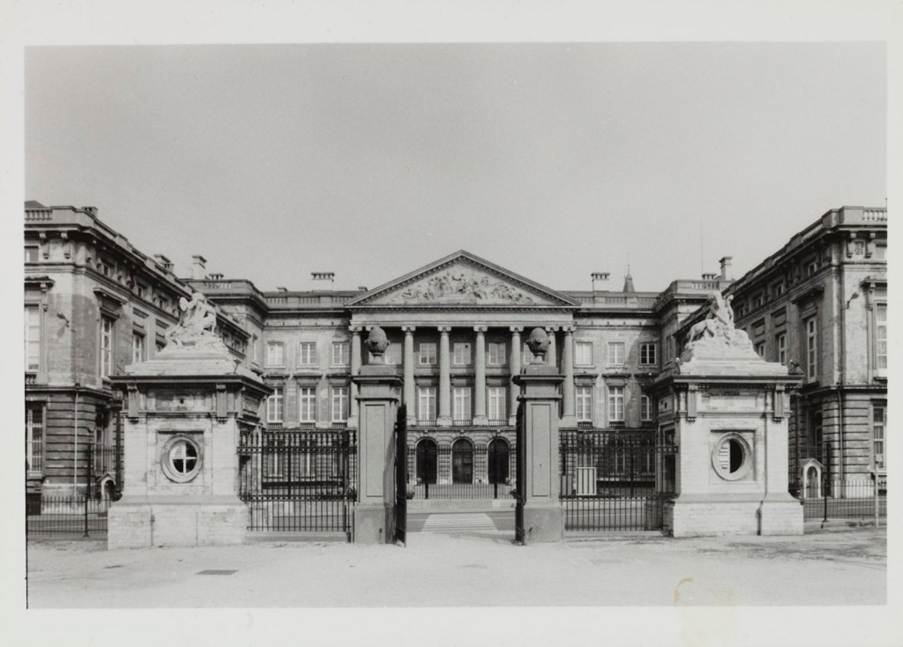
Figure 1- Entrance of the Paleis der Natie/ Palais de la Nation. @Monument Heritage Brussels
Belgium has been a parliamentary-constitutional state since its foundation in 1830.
Between the late 19th century and the mid-20th century, it experienced gradual
democratisation with plural male voting rights being granted in 1893, singular male
voting rights in 1919 and eventually women’s suffrage in 1948. Between the 1970’s and
2010’s, consecutive state reforms would turn the once-unitary country into a federal
system, and a bicameral parliamentary system into a de facto monocameral system.
Caught between increasingly autonomous regional legislatures and increased EU
competences, it is fair to say that Belgium’s Chamber of Representatives is not the
centre of political influence it once may have been. Nevertheless, discussions on the
future of the Belgian political system have always remained relevant in the country’s
politics, especially with recent debates taking ideas of ‘refederalisation’ out of the taboo
sphere they once belonged to. This overview aims to sketch out an outline of Belgium’s
political system and the function of its federal parliament anno 2025.
Belgian Federalism
Belgium is a rather unique case in terms of its constitutional makeup in that it has a
total of six parliaments. As mentioned above, ethno-linguistic tensions between Dutchspeaking and French-speaking groups made way for six consecutive state reforms in 1970, 1980, 1988-89, 1993, 2001 and 2011-2012. These reforms have transformed
Belgium from a unitary state to a federal one, making it a rare case of centrifugal
federalism.
The development of federal Belgium has been closely linked to the concept of
consociationalism, with constitutional power-sharing mechanisms functioning to avoid
conflict between the aforementioned ethno-linguistic groups. In other words, the state
reforms worked to suppress tensions between the Dutch-speaking and French-speaking
groups by respectively giving both communities increasing political autonomy. This
process of increasing regional autonomy made way for a unique system where
competences are divided across the federal level and across political bodies referred to a
Communities (i.e. Dutch-, French- and German-speaking communities) on the one hand
and Regions (i.e. Flanders, Wallonia and the Brussels-Capital Region) on the other
hand. As a consequence, Belgium today has a bicameral federal parliament as well as
parliaments organised at the regional and community levels, including:
- The Flemish Parliament that treats both the competences that the federal level
has transferred to the level of Flanders and the Dutch-speaking community (in
Flanders as well as the Brussels-Capital Region). - The Walloon parliament that treats the competences that the federal level has
transferred to the level of Wallonia. - The parliament of the Brussels-Capital Region that treats the competences that
the federal level has transferred to the Brussels-Capital Region. - The parliament of the Federation of Wallonia-Brussels that treats the
competences that the federal level has transferred to the level of the Frenchspeaking community (in Wallonia and the Brussels-Capital Region). - The parliament of the German-speaking community that treats the competences
that the federal level has transferred to the level of the German-speaking
community.
Throughout these six constitutional reforms, the Belgian federal state has thus
transferred an increasing number of competences to the Regions (e.g., economy,
employment, housing, transport, town planning…) and the Communities (e.g.,
education, culture, language legislation, integration, certain aspects of welfare, health
care and child allowances…). Nevertheless, the federal state still decides on a number of
influential policy areas such as defence, public finance, justice, social security, foreign
affairs, and large portions of home affairs and public health.
Since the state reform of 1993, Article 35 of the Belgian constitution has stated that the
federal level’s competences are only those which the constitution has explicitly granted
her, with all other competences not specifically granted to it (called residual
competences) belonging to the Regions and Communities. However, even if this may
legally be so, in practice a ‘special majority law’ (see infra) stating the would-be
competences of the federal level still needs to be passed in order for Article 35 to become
meaningful. As this has not happened in the 30 years since the initial reform was
passed, the federal level retains the ‘residual competences’ in practice, while the Regions
and Communities get only what is explicitly assigned to them by the Belgian
constitution.
Constitutional Institutions and Structure of Parliament
Belgium is a constitutional monarchy and a parliamentary democracy under the rule of
law. The three branches of the federal government are thus divided as follows:
- The legislative branch, jointly exercised by the King, the Chamber of
Representatives and the Senate (Art.36 Gw.) - The executive branch exercised by the King (Art. 37 Gw.)
- The judicial branch, exercised by the courts (Art. 40 Gw.).
The main political actors and institutions on the federal level are therefore: the King as
the third branch of the legislative branch and the head of the executive branch (1), the
150 members of the Chamber of Representatives to whom the King is responsible (2),
the 60 members of the Senate (3), and the courts (4) among which the Constitutional
Court and the legislative division of the State Council are the most prominent in
political affairs.
‘The King’ stands to mean the monarch and his ministers. While formally holding a
prominent role, the monarch is inviolable, not politically responsible and incapable of
individual political action (Art. 88 Gw.). He therefore has no legal political power, and
his ministers are thus responsible for his actions which hold political or criminal
meaning (Art. 88 Gw.). After an election, the King appoints the ‘formateur’. Typically
the leader of the biggest party, the formateur is mandated to form a governing coalition
and establish the federal government, usually becoming the prime minister upon
formation. In recent years, long government negotiations have been subject to critique
by citizens and commentators abroad, calling into question the effectiveness of
Belgium’s constitutional structure.
The ministers forming the federal government, are responsible to the federal
parliament, which can ‘kick out the rascals’ through a vote of no confidence. The federal
government consists of maximally 15 ministers which, sometimes disregarding the
prime minister, is comprised of an equal amount of Dutch and French speakers.
Similarly, the federal parliament (both Senate and Chamber) is divided into two
linguistic groups, which shows its significance when it comes to the passing of ‘special
majority laws’ (see infra) and constitutional reforms as in those cases, a majority must
be obtained in both linguistic groups before a law can pass.
Weakening Bicameralism
The political power of the Senate relative to the Chamber of Representatives has
strongly decreased in recent decades. In contrast to 1830, when its establishment was
deemed politically necessary by the Belgian Founding Fathers, the recently formed socalled ‘Arizona’ government has even promised to bring about its total abolition during its legislature (2024-2029).
While initially holding equal power relative to the lower house, the state reform of 1993
introduced the concept of functional federalism. For the Senate, this meant that it would
no longer represent the Belgian nation but rather act as a forum of debate between the
Regions and Communities and serve as a ‘chamber of reflection’. After the sixth state
reform in 2011-2012, a constitutional reform (not to be confused with a state reform) on
6 January 2014 continued this trend of differentiating the role and tasks of the Senate
vis-à-vis the Chamber of Representatives. Since 2014, the Senate’s legislative role has
been largely limited to constitutional revisions and special laws, with most laws now
being passed through a monocameral procedure in the Chamber of Representatives.
Main Legislative Process for Federal Laws
Depending on the required majority, as well as the number of chambers required for
laws to pass, we can distinguish between ‘normal laws’, ‘special majority laws’, as well
as ‘monocameral’, ‘bicameral’, or ‘optionally bicameral laws’.
Special majority laws require a passing vote in both the Chamber of Representatives
and the Senate. This means that over 2/3rds of total MPs, as well as a majority of MPs
across both linguistic groups must be present to vote for a special majority law to pass,
also making them bicameral laws by nature. After the legislative procedure for
constitutional revisions, which require a 2/3rds majority in both Senate and Chamber
after snap elections, special majority laws are the most demanding in terms of passing
requirements. In contrast stand the ‘normal laws’, which require only a simple majority
in the Chamber of Representatives in order to be accepted, making them monocameral.
As these are the most common kind of laws being treated in parliament, the process of
how a ‘normal law’ comes into being is discussed below.
The creation of a ‘normal law’ happens in six essential ‘steps’: the initiative (1), the
advice of the legislative department of the State Council (2), the discussion and vote (3),
the second reading (4), the ratification and promulgation (5) and the publication and
entry into force (6).
All laws depart from a draft bill that is initiated by either the King or a member of the
Chamber of Representatives (the former is the most common and will therefore be the
main focus for the remainder of this section). Before any draft bill can be processed, it
must pass through a vote of consideration. This is to ensure that the draft is not harmful
to the public order, unconstitutional or ‘unserious’.
In the second stage, draft bills proposed by the King are required to be submitted to the
legislative department of the State Council for non-binding technical legal advice. This
submission for advice is mandatory unless the government calls for high urgency. In this
case the Sate Council only puts forward advice on whether or not the bill falls within the
competencies of the federal government (Art. 3 RvS-wet). Draft bills proposed by a
member of the Chamber are not required by law to be submitted for advice, even though
this may still happen under specific circumstances (Art. 4 RvS-wet).
After a draft bill proposed by the King has received advice from the State Council, it will
be assigned to the relevant commission within the Chamber of Representatives, where it
is discussed and voted. In the commission, amendments can be made to either scrap,
adjust or add to a draft proposal. After a vote in the commission, the (amended) bill is
transferred for discussion in the plenary meeting and, in the case of monocameral laws,
the final vote. Given that most laws are ‘normal laws’ and thus monocameral, it is
possible, yet not mandatory, to hold a second reading of a draft bill, be it in the
commission or in the plenary (Art. 76, derde lid Gw.).
After this second reading, or immediately after the first vote in the plenary, the
parliamentary work surrounding the draft bill is over and the bill is transferred to the
King for ratification and promulgation. The ratification implies that the King (the
monarch), as head of the third branch of the legislature and under the responsibility of
his ministers, expresses his agreement with the draft bill after its treatment in the
Chamber of Representatives.
The promulgation is the act whereby the King, as head of
the executive branch confirms the existence of the law and commands that it be
published in the Belgian Official Gazette. Both the ratification and the promulgation
take place by means of the same signature but are seen as two different legal acts. Aside
from the King, two ministers also sign the law, namely the minister of Justice and the
minister whose department is responsible for the execution of the law in question.
Finally, the law is published in the Belgian Official Gazette when the executive branch
deems it opportune to do so, without exceeding a reasonable term.
The law is published in Dutch and in French, with the assumption juris et de jure that all citizens know the law. In principle, all laws enter into force ten days after they are published. However, the exact moment of entry into force can be altered concerning the entire law, or even specific articles within the law. A law is only binding after its publication and entry into force (Art. 190 Gw.).
Bibliography
De Jonckheere, M. & Debersaques, G. (2019). Inleiding tot het recht. Die Keure.
Deneckere, G., De Wever, B., De Paepe, T., & Vanthemsche, G. (2020). Een geschiedenis
van België. Lannoo Meulenhoff-Belgium.
Hondeghem, A., Van Dooren, W., Verschuere, B., & Fobé, E. (2022). Handboek
bestuurskunde: organisatie en werking van het openbaar bestuur. Vandenbroele.
Poplier, P., Sinardet, D., Velaers, J., Cantillon, B. (2012). België, quo vadis? Waarheen
na de zesde staatshervorming? Intersentia.
Van Damme, M. (2015). Overzicht van het grondwettelijk recht. 2de, herz. dr. Die Keure.
Witte, E., Luyten, D., & Meynen, A. (2016). Politieke geschiedenis van België: van 1830
tot heden. Manteau.
 The Analytic Hour
Leave a comment